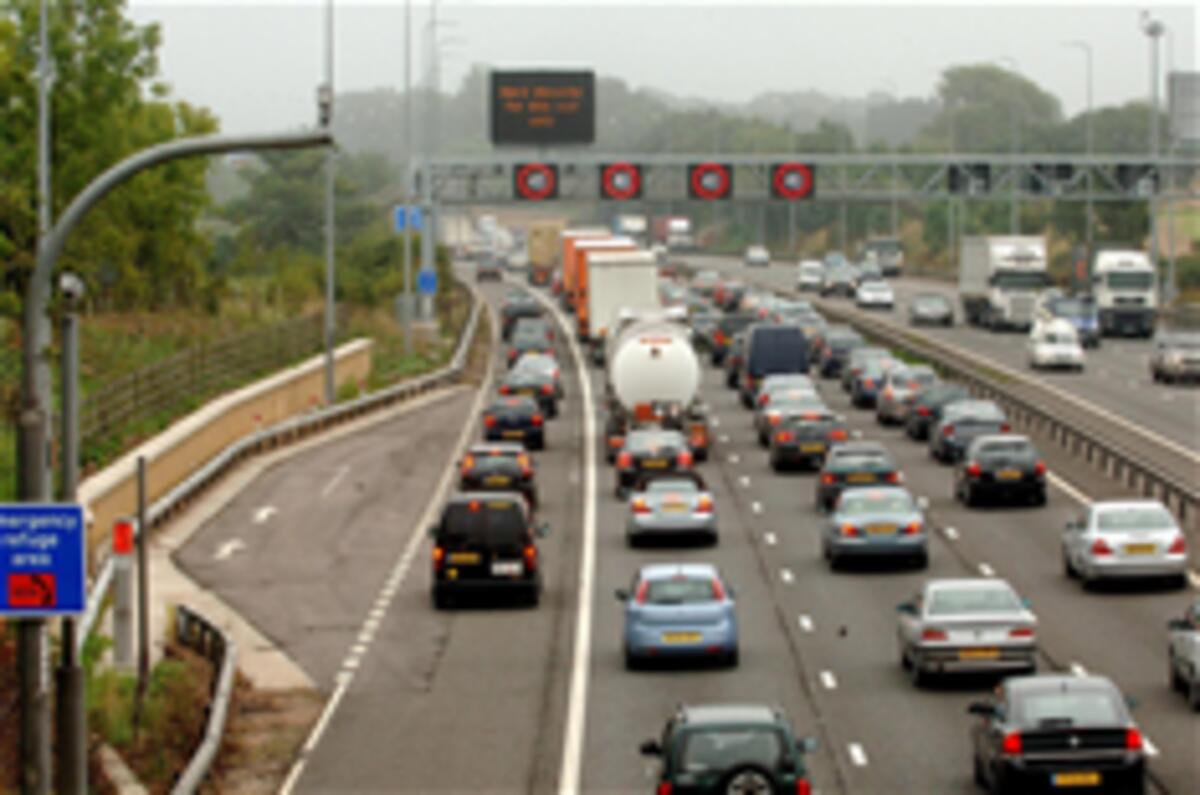

British motorists face permanent 60mph speed limits on up to 250 miles of the motorway network under a little-known government scheme for the introduction of ‘controlled motorways’.
To be rolled out over the next five years, controlled motorway speed limits could be pushed down to 50mph and 40mph at the busiest times of the day, according to government documents.
The scheme will deploy an enormous array of new technology (including average speed cameras and sensors buried in the road surface) and will usually be introduced alongside ‘hard shoulder’ running, where the hard shoulder is used as a fourth lane on very busy stretches of motorway.
According to a Department for Transport report for the Secretary of State for Transport, “The controlled motorway (CM) system is designed to minimise the risk of flow breakdown and reduce accidents, thereby producing more reliable journey times.”
However, it goes on to say, “Mandatory speed limits are set automatically… 60mph and 50mph speed limits are displayed on the overhead gantries to address congestion. When necessary to protect traffic from queues, 40mph limits can also be set.”
In a surprise move, the Highways Agency has also been given its own Digital Enforcement Camera System (HADECS), which downloads information about speeding cars directly to “a secure police office”.
Following research that has been conducted on the M42, speed limits between 40mph and 60mph are now regarded by the DfT as ideal for minimising CO2 emissions.
“Emissions per mile fall as average speed increases to 40-50mph, where the fuel efficiency of the engine is greatest, and then rises as the average speed increases towards 70mph and fuel efficiency falls,” the report states.
The DfT’s initial plans for controlled motorways are ambitious, covering the whole of the M25, stretches of the M40, M3, M4 and M23, as well as most of the roads around Birmingham.
The M1 into Yorkshire and the M6 between Birmingham and Manchester are earmarked, as is the Manchester ring road and M6 north of Preston. Hard-shoulder running was trialled on the M42 near Solihull, and is now live on the M6.
The DfT has been considering road charging in these areas for more than a decade. Perhaps it is no coincidence that part of the CM technology is also ideal for tolling.
Ramp metering uses slip-road traffic lights to regulate traffic flow onto the motorway. But running vehicles more slowly on and off the motorway could make it easier to introduce tolls, probably via windscreen-mounted charge cards.