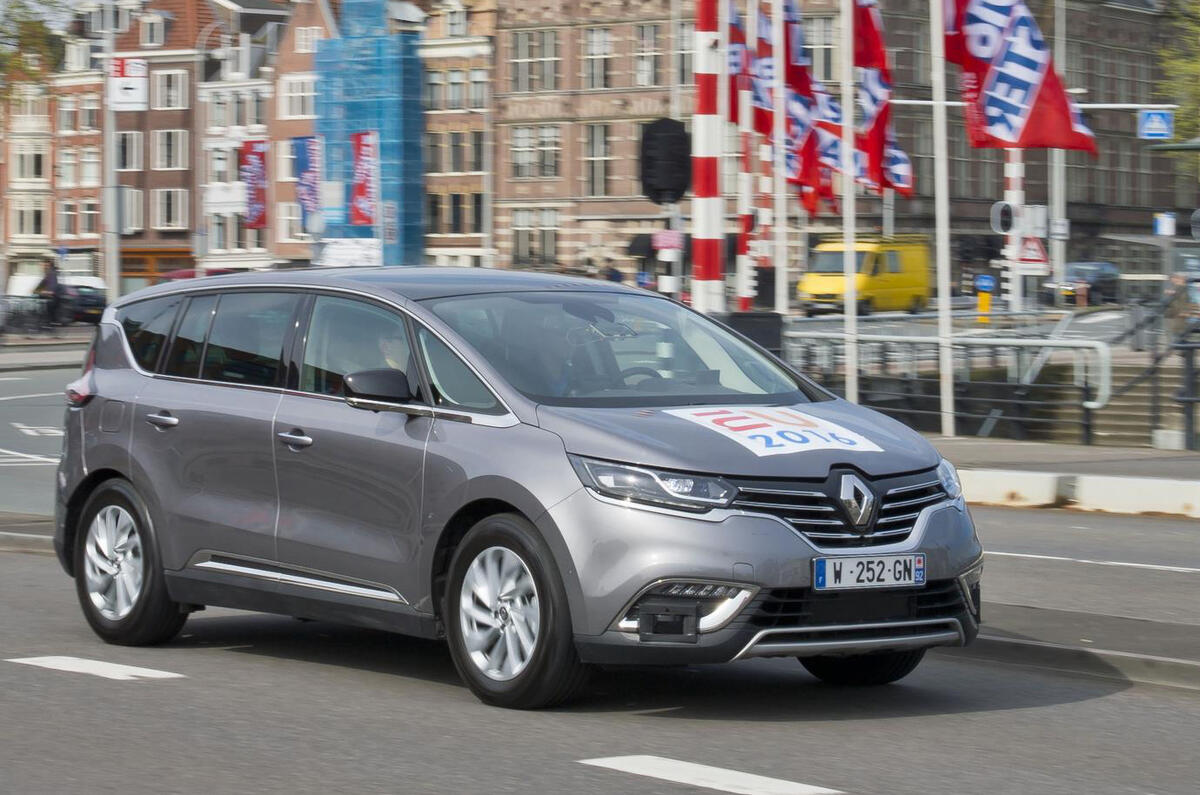

Renault has revealed three Espace Autonomous Drive demonstrators to 28 European Union Transport Ministers as part of its push for the adoption of driverless technology.
The ministers were meeting in the Netherlands to sign the Amsterdam Declaration in favour of autonomous cars.
Renault claims the Espace Autonomous Drive has already gained “several hundred hours” of autonomous testing on public roads across Europe.
It says tests have shown the technology is fast becoming safer than human control, claiming that more than 90% of accidents are caused by human error. Renault therefore argues that using autonomous cars will drastically reduce accident rates.
Video
At the New York motor show last month, Renault-Nissan CEO Carlos Ghosn pledged to bring driverless cars to the mass market, with the expectation of delivering a car that could drive itself without human input by 2020.
The first step towards this goal will come with the 2017 Nissan Qashqai, which Renault-Nissan has said will be able to drive autonomously in a single lane of a motorway.
Renault-Nissan faces stiff competition in the race to produce the first mass-produced autonomous car. Last year, Tesla introduced autonomous features via a software update on its Model S, and more recently, technology that allows owners to summon their car.
It’s clear driveless technology is becoming a more prominent feature for the motoring industry, with more than half of new cars sold in 2015 featuring some form of autonomous system. Of the sytems currently on offer, the majority of car buyers choose emergency braking and blind spot monitoring.
However, a recent study by WhatCar? revealed that most British buyers still choose optional infotainment features over driver assist functions.
Cameron Tait