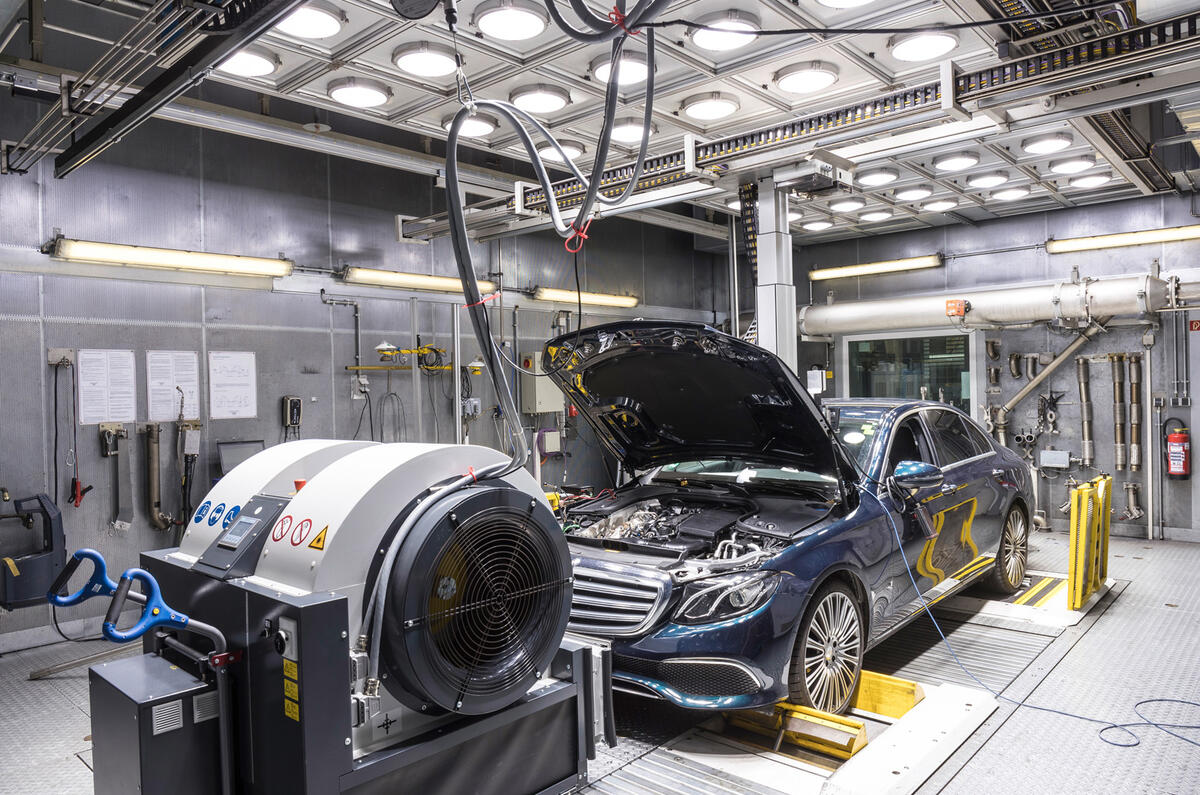

New allegations of diesel emissions manipulation have been levelled against Daimler after a German environmental group claimed to have found eight new ‘defeat devices’ in a Euro 6-classified Mercedes-Benz E-Class.
The Deutsche Umwelthilfe (DUH) organisation discovered that emissions of poisonous nitrogen oxide (NOx) spiked by up to 500% during tests of a 2016 Mercedes E350d Bluetec.
Mercedes parent firm Daimler has previously been forced to recall 774,000 diesel cars after German KBA association found “unauthorised defeat devices” in four-cylinder diesel engines with an SCR filter using AdBlue to reduce emissions. The recall affected around 90,000 cars in the UK.
The KBA said it was “aware” of the eight defeat devices found by DUH in models with the OM 642 diesel and said that there were “not inadmissable”, meaning they judged that they were allowable.
Daimler argued at the time that car makers are permitted to switch off the SCR filter in diesel engines in the interests of engine longevity. However, critics have argued that car makers have used loopholes in the rules to make cars appear clean in laboratory tests while allowing significantly higher emissions in normal driving.
DUH claimed six of the defeat devices found on the six-cylinder engine in the E350d related to the SCR filter system, reducing the amount of AdBlue cleaning fluid used, while two affected the vehicle's exhaust gas recirculation system.
DUH said its tests related to a single model but would be relevant to other vehicles using the same engine, citing the ability of manufacturers to use the same registration data for a particular engine across a number of different models. Model lines using the OM642 engine with the Bluetec SCR system, for example, include the E-Class, GLC, GL and G-Class.
DUH did not give a figure for the cars affected but estimated the “vast majority” of diesel passenger cars with Euro 5 and early Euro 6a and 6b versions of the six-cylinder engine will be affected.
“Daimler couldn’t plausibly claim that the defeat devices were needed for engine protection,” said Jürgen Resch, federal managing director of DUH. “The reason is as simple as it is cynical: it is about maximising profit at the expense of the environment and the health of the city dwellers.” Daimler denies these allegations.
Two of the defeat devices depend on what DUH called an "ageing factor" that lowers the point at which the shutdown devices start. In two cases, this happens after just 1% of the vehicle’s life expectancy, within a few thousand kilometres. A further reduction occurs after around 20% of vehicle life.