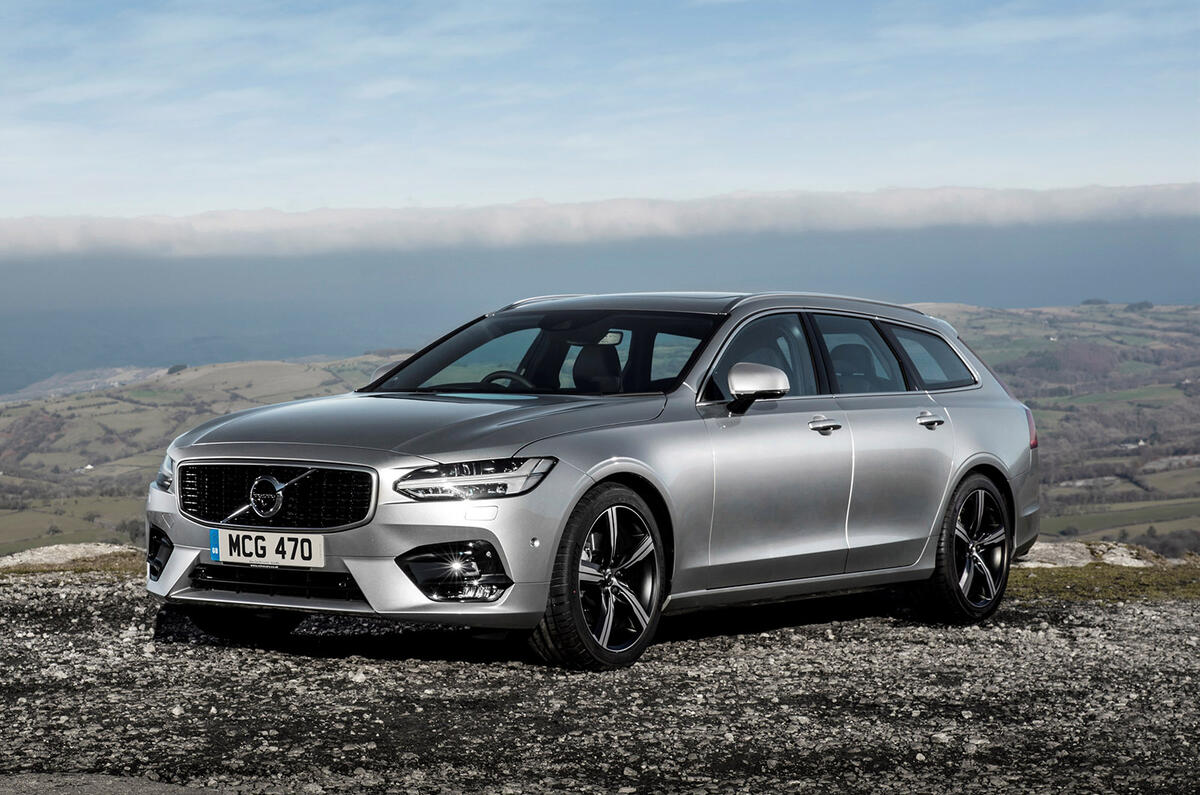

Volvo has added a 247bhp petrol engine to its largest family of cars, bringing the petrol-powered range for the Volvo S90, Volvo V90 and Volvo XC90 to three engine derivatives.
Like all other engines which power the 90 series, it’s a 1969cc unit, boosted via turbocharging to produce 258lb ft. It’s the most powerful non-hybrid in the range of each car, and is made of aluminium and lightweight aluminium alloy.
The engine is expected to trickle down into high-spec versions of the Volvo V60 and Volvo S60, although Volvo will likely stop short of offering it in 40-badged cars.
In the S90, Volvo claims the engine will return 42.8mpg and 154g/km CO2 - 14g/km down on the 2.0-litre Ingenium petrol-engined Jaguar XF, despite having the same power output and 11lb ft less torque.
The new derivative is only available in high-spec R-Design and Inscription specs, and starts from £41,120. Top speed is 140mph, and 0-62mph passes in 6.8sec - 0.5sec and 12mph slower than the similarly engined Jaguar XF. Deliveries start imminently and orders are already open.
The move represents the next prong in Volvo’s no-diesel future, under which the brand is ending the production of oilburners as each model is phased out. The S60, due early in 2019, won’t be offered with a single diesel, with only 1.5-litre three-cylinder, 2.0-litre four-cylinder and T8 plug-in hybrid petrol engines the only ones on offer.
Across the first half of 2018, 61% of Volvo's sales were diesels, compared with 39% petrols and hybrids. Across the car industry during the same period, 32% of new registrations were diesels - a decline of more than 30% on the same period in 2017.
Read more:
Volvo S90 review
2018 Volvo S60 to face 3 Series with keener handling and plug-in variants
Volvo targets 33% autonomous sales and 50% subscription sales by 2025